
Field Notes
Exterior insulation without the extra trade
September 29, 2026
Get exterior insulation without hiring another trade.
Every stud in a framed wall is a thermal bridge, and the only cure is a continuous layer of insulation outside the framing, or a different wall assembly altogether like SIPs or ICF. The 2021 IECC wrote it into the tables: in climate zone 3 a wood-frame wall needs R-20 in the cavity, or R-13 cavity plus R-5 continuous, or R-15 continuous alone; zone 4 needs R-30, or R-20 plus 5, or R-13 plus 10. Zone 2 still allows R-13 cavity alone, and Austin’s amended 2021 code already asks for more than that. The direction is clear. Continuous insulation is where wall codes are going, and a builder who learns to do it now is ahead of the next code cycle. In our view, it is the simplest way to add exterior insulation if the budget allows.
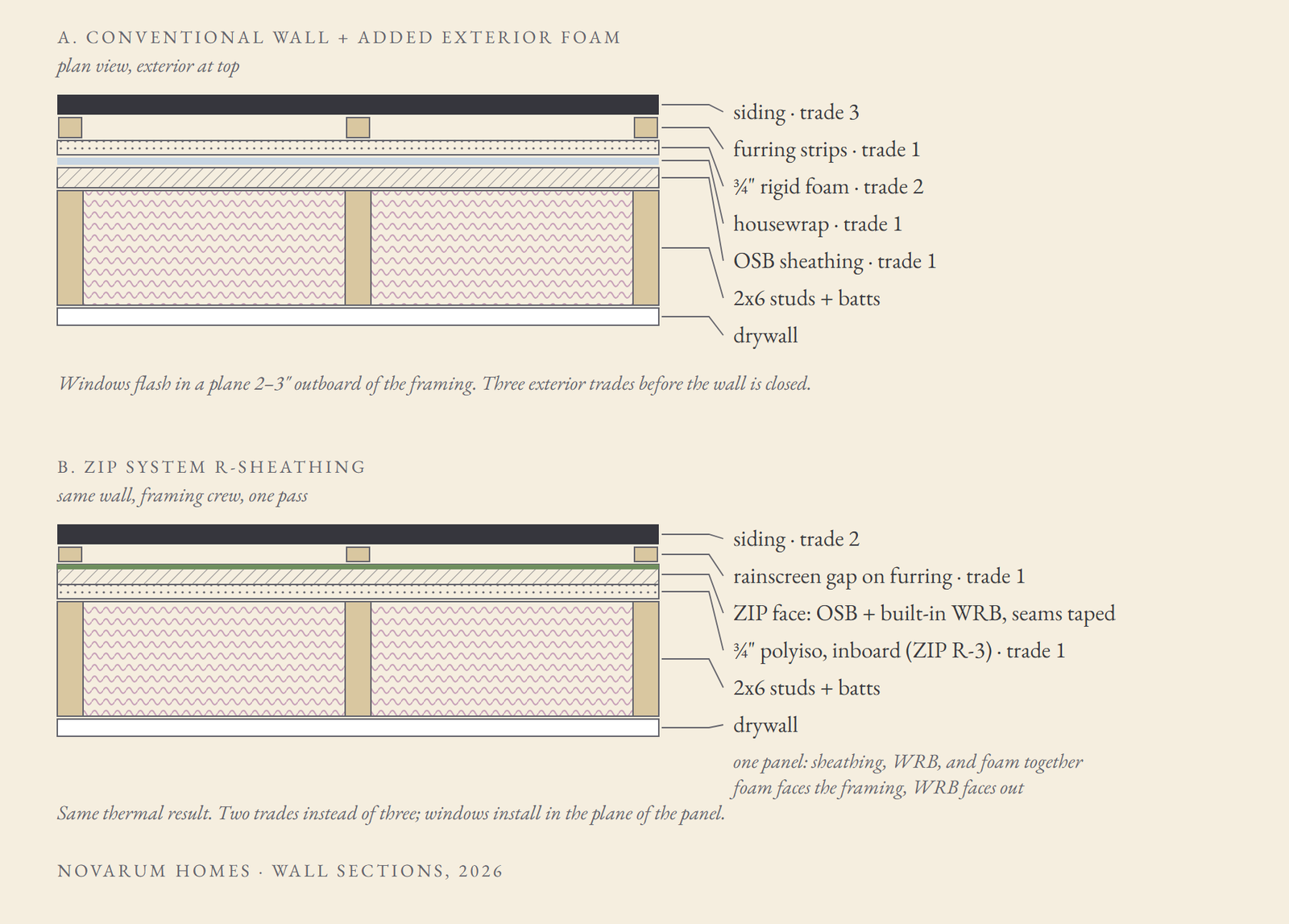
The sequence is where exterior insulation gets complicated. Conventional exterior foam means a framing crew, then, after the housewrap, an insulation crew, then furring by either the framers or the insulation crew, then a siding crew that has to flash windows in a plane that no longer lines up with the framing.
Huber’s ZIP System R-sheathing collapses that sequence. It is the same taped structural panel with the water-resistive barrier already on the face, laminated to a layer of polyiso foam on the back. The foam goes against the studs, the green face goes out, the seams get taped, and in one pass by the framing crew you have sheathing, air barrier, water barrier, and continuous insulation. Windows install in the plane of the panel like any other window. Four thicknesses are offered, sold as R-3, R-6, R-9, and R-12 at 1, 1½, 2, and 2½ inches (Huber lists the tested values as R-3.6 to R-12.6), and the product carries ICC-ES evaluation report ESR-3373 for wall bracing.
There is an issue with the thicker insulation: long nails. An R-9 or R-12 panel needs a 3½- to 4-inch nail to get the required 1½ inches into the stud for shear, and that is harder to execute with a regular crew. Shear values are published for specific framing species, and there is some skepticism about shear through a foam layer; on a hard-wind site, have your engineer look at the bracing plan. And there is a material premium over plain OSB and housewrap; Fine Homebuilding’s comparison put standard ZIP with tape at about 46 cents a square foot against 40 cents for OSB and housewrap, and the insulated panel costs more again. In my view, ZIP System is a no-brainer over regular housewrap: it is easy to install, and it is a ready, vapor-open, continuous moisture-control layer. It’s just a matter of the added cost of the foam. What you buy with that premium is the removal of an extra trade. Framers who do sheathing will know how to use this product; it goes on just like sheathing, only a little thicker.
The vapor question is simpler in our climate than people fear. The 2021 IRC requires no vapor retarder in zones 1, 2, and 3, and forbids a Class I retarder on the inside of the wall in zones 3 and 4. So the wall with foam outboard of the cavity dries to the inside, which is the direction it needs to dry in a cooling climate. Do not add poly, do not use vinyl wallpaper, and the assembly will be fine.
Our model home in Winona was monopoly-framed (no eaves; they are added afterward) with ZIP sheathing and a separate layer of exterior polyiso insulation, the approach Matt Risinger popularized on the Build Show. We then realized it would be faster to have the framers install sheathing with the foam already attached, because there is less detail work to think about.
Sources & Further Reading
Where this comes from
- Pacific Northwest National Laboratory, Building America Solution Center, 2009–2021 IECC and IRC minimum insulation requirements.
- City of Austin, 2021 IECC as amended; City of Tyler, Current code references; Texas Comptroller, State Energy Conservation Office, Single-family residential energy code.
- Huber Engineered Woods, ZIP System Insulated R-sheathing; ICC Evaluation Service, ESR-3373.
- Fine Homebuilding, “Working With ZIP R-Sheathing”; Green Building Advisor, “Working With ZIP System R-Sheathing”.
- International Code Council, 2021 IRC Section R702.7 Vapor retarders.
- Matt Risinger, The Build Show.
Building in East Texas?
We design and build a few homes a year this way, and we document every assembly so other builders can build it too. If you want to see this wall assembly in person, come and look at ours, or: