
Field Notes
How a small builder can run on AI
September 2026
Chat agents and one folder tree; what it actually looks like when a small design-build firm runs its daily operations on AI.
The Problem
A big office’s paperwork, a small firm’s staff
Most homes in America are built by very small companies. The National Association of Home Builders counts more than 813,000 non-employer residential building firms, close to 80 percent of the industry, and the median NAHB builder member employs six people. A firm that size still has to do everything a large builder does: track material from quote to delivery, log every receipt against the right cost code, keep a punch list, record client decisions, schedule trades, and remember what was said on many a phone call during the week.
The usual answer is that the owner carries it in their head and their phone. That works until it doesn’t. It’s definitely not scalable. The other answer is to use software, like JobTread, Buildertrend, BuildXact maybe. However, we have tried these, and you are limited to how that company thinks you should work. In addition, the user interface is often cumbersome, adjusting anything takes window after window and click after click. There is also a steep learning curve. What if that does not work for your firm? There has to be an easier way.
What about AI? The Census Bureau’s Business Trends and Outlook Survey put AI use at 17 to 20 percent of U.S. businesses through spring 2026, concentrated in large firms. Construction sits near the bottom. That gap is the opportunity, because none of what follows requires a large firm.
Novarum Homes is a design-build company in Winona, Texas. This is a plain description of the system we run on. We have actually been using this for the better part of this year.
The One Rule
One folder tree, and every agent reads and writes it
The single most important design decision is not the LLM model or the chat app. It is that there is exactly one folder structure, every project lives in it the same way, and every AI agent, every script, and every human uses that structure as the system of record. The chat is just the doorway.
The agents run on a virtual private server (VPS). They populate those folders, create new folders in the hierarchy, and find files anywhere in that tree. A scheduled job copies the capture area into the shared company drive every morning, so the field, the office, and the design desk all see the same files. Nothing important lives only in a chat history.
You might say that you cannot trust AI: it hallucinates and produces slop, right? A lot of those poor results stem from treating AI like a magic box, where one sends a request and then expects really good results. But the output is only as good as the context and knowledge it has about you and your methods. If you use ChatGPT or Claude in a browser window and keep having to copy and paste context, it will cost you a lot of usage credits and never produce great results. This is because it’s always going to be missing something. Instead, you build fleshed-out folders and a directory of what can be found where; AI can help you build this. The more you fill in the context gaps, the better the results get. And the models are continuously getting better in parallel.
The Jobsite
A photo and one sentence
The agents live in a chat like WhatsApp because every crew member already has a smartphone and is already using chat apps. Each group has one job. There is a logistics group for material, a tasks and scheduling group, a receipts group, a client-decisions group, and a bulletin channel the agent posts to every morning with the day’s field tasks, pickups, and even weather warnings.


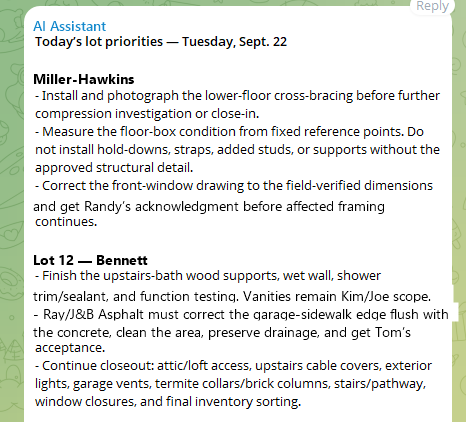
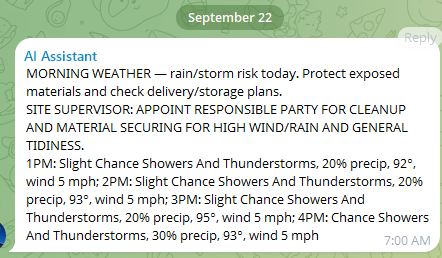
A crew member can send a photo of a cracked pier bracket with the words “Lot 12, needs replacing before the inspector Friday.” The agent saves the photo into the job’s photo folder, appends a row to the task file with a date, an owner, and a deadline, checks it against the master task list so duplicates get flagged, and confirms that it has processed that upload in one line. On Friday morning the reminder fires in the same group. When I ask for the punch list, a script assembles every open defect with its photo into a single PDF I can hand to a sub-contractor or an inspector.
A receipt works the same way, with more discipline. The agent reads the photo, extracts the vendor, total, and last four digits of the card, and proposes a cost category and a job (which of course is customizable to how your company does its own cost codes). Nothing is filed until a human confirms. Only after confirmation does the receipt get forwarded to the bookkeeper (you may not even need one if you get this set up properly), and every forward is recorded once so it can never be sent twice.
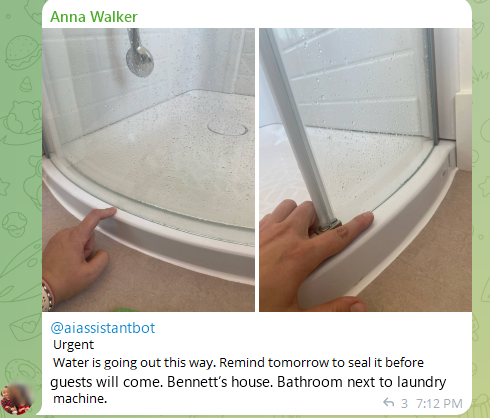
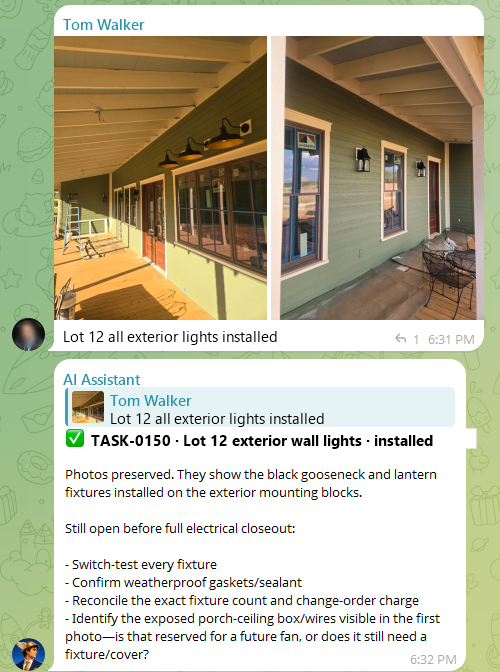
The operating principle is that the agent captures and the folder holds. The chat is never the record. If the phone is lost or the group is deleted the data still exists on the server. This is what agentic AI can look like in your construction business. It’s not at the level of a ChatGPT subscription in the browser where you must continuously upload context. This same agentic AI system can address hundreds of client decisions made over months in texts, emails, and site walks. Then there are also the conversations that a builder has throughout the week. Have you ever considered recorded meeting minutes?
Want to see it running?
We take up these topics and show our screens at our free monthly Tyler meetup and we help other contractors learn about implementing AI in their business. If your firm runs on a phone and your memory, we should talk.